Day 5 of the Narmada Parikrama: laundry on a stone, and a night by Babaji's dhuna
Today our day started super calmly. We got up a bit later and right away started chatting about our adventure of yesterday. Then we walked to the Narmada and did our puja. And of course I took a nice plunge in the water. Wonderfully refreshing!
Then straight on to the laundry, because our clothes had changed from a nice white into a less nice shade of brown.
Doing the laundry here at the ashram is not like at home in the Netherlands, where you put everything in the washing machine. Here you have a bucket with washing powder and a stone. First you let your clothes soak in the suds for half an hour. Then you slap them against the stone to literally beat the dirt out. Then a bit more with a brush and some washing powder to scrub away the stubborn stains. And of course rinse a few times with water. Job done, and your gym workout is out of the way too.
After we had hung up the clothes, we had a lovely breakfast: some puris left over from yesterday and dal with rice.
The drying gave us plenty of time to make some Instagram reels and work on the website. Around three o'clock the clothes were dry and we packed our things to leave for the next ashram.
The family did warn us. It was the closing festival of Durga in this area, there could be a lot of drunk people and that could get quite dangerous. Wouldn't we be better off waiting until tomorrow? But we were too motivated and wanted to move on again. So off we went, on to the next adventure.
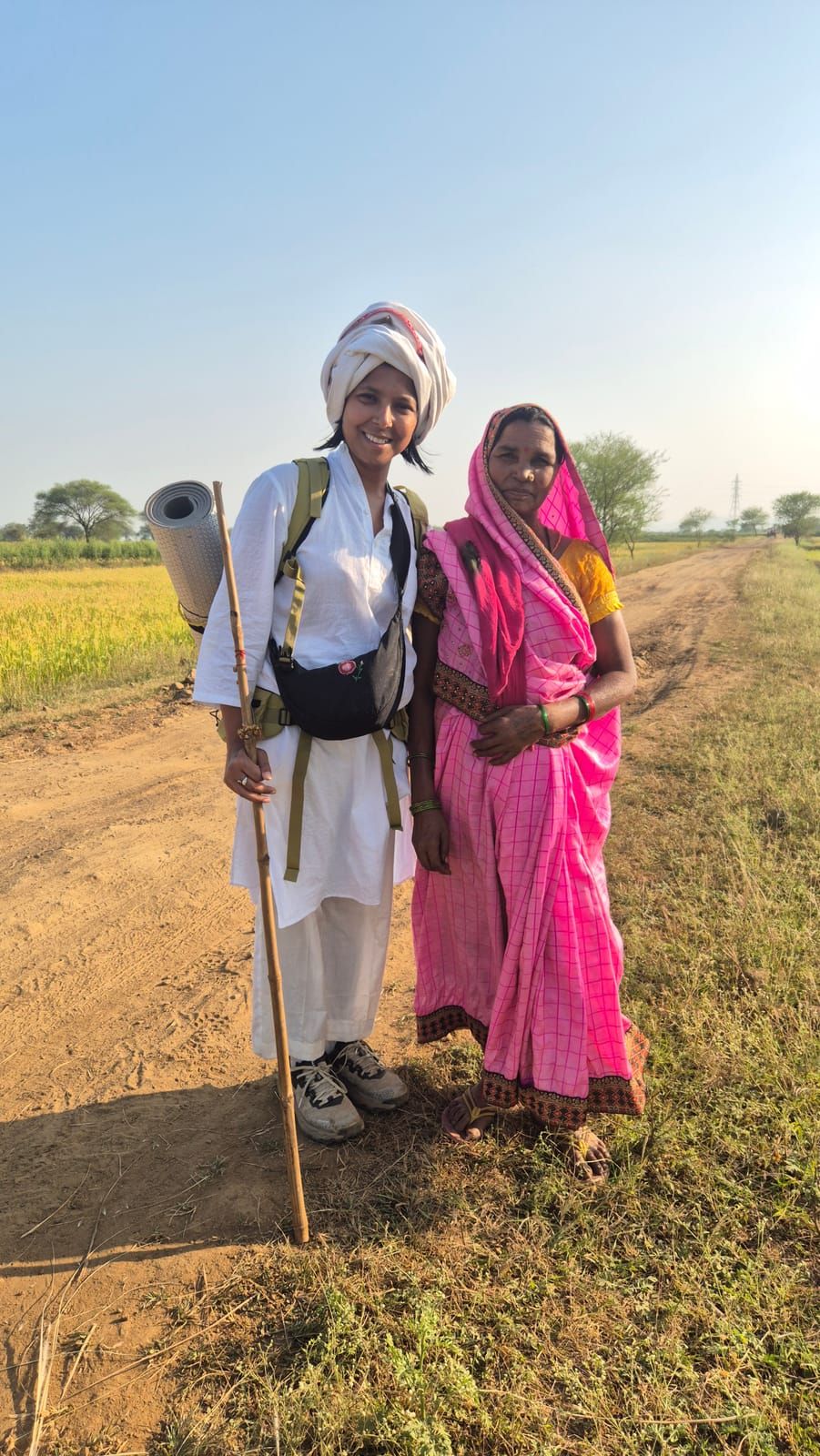
We had a lovely walk through the countryside and asked the way here and there. Along the way we were advised to find an ashram soon. After six kilometres we arrived, thanks to a kind lady who kept pointing us in the right direction. She called Yasha 'maiya' the whole time, which means mother, even though she herself was quite a bit older than us.
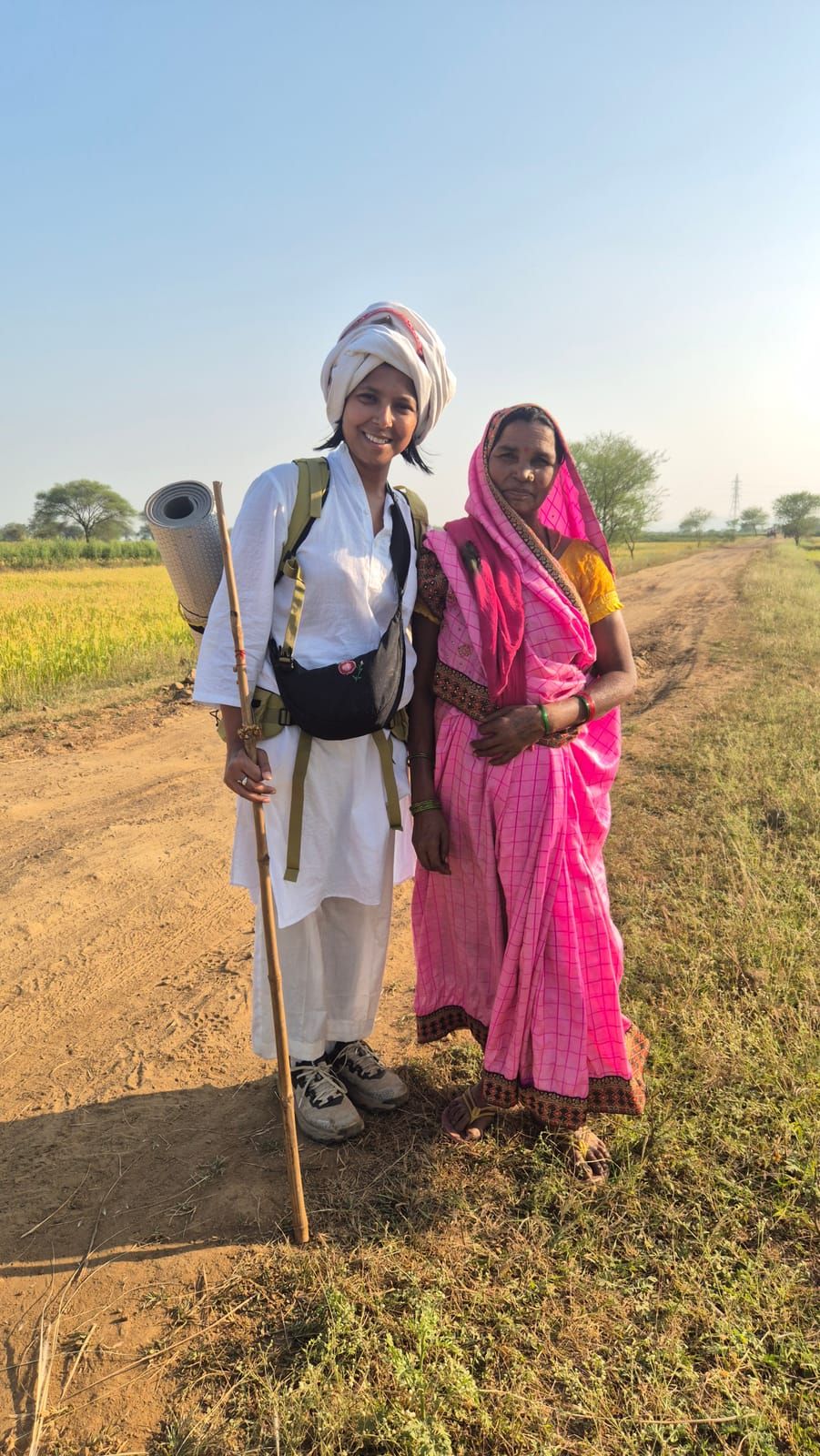
Once we arrived at the ashram, Tulsi Ghat, I now hand over to Yasha.
Shivni Sangam had been kind to us. After a very comfortable stay, we decided to move on to the next ashram. We need to keep moving; stopping in one place breaks the rhythm.
“Tulsi Ghat? Only 5 km,” said the elder brother of the priest family living at Shivni Sangam. “Same as the ashram here.”
Those few words were enough. They felt reassuring. Motivating. No more creepy chillum ashram.
We packed our bags. We took the customary selfies with everyone. We folded our clothes, washed with our own hands, with hard work, and successfully at last. Then, with new spirit, we set off for the other ashram.
Walking felt good. The unpaved village road and Narmade Har, just these two, brought back the energy and the zeal to walk. Every Har Narmade called out to us on the way felt like a small cheer, an approval of our decision to walk again.
We crossed Bor Tola, a village in Dindori district. And then, of course, like every other day, a crossroad. Follow the main road, or take the dusty road to the ashram on the ghat?
Of course we wanted to be close to Reva. But chillum ashrams, godman babas, angry babas… we had been through that already, and this time we wanted to avoid it.
It was already three in the afternoon. The next ashram was ten kilometres away. It is wise to reach an ashram before the sun goes down. Here it starts getting dark by half past six.
On the banks of Maa Narmada, evening seems to fall even sooner, as if she goes to sleep early. By half past seven a silence spreads over the bank. Only the glow of fireflies, the screech of monkeys, and the flutter of bats.
So we took the footpath, and set off towards Tulsi Ghat.
Tulsi Ghat: the dhuna and Babaji
At this ghat, Babaji lives in the village community hall, which serves as the ashram here. The community hall is Babaji’s place, the place of his dhuna, his sacred fire. His chillum and his four pots: everything stays there.
When we reached the ashram at four in the afternoon, two or three idle men from the village had gathered around Babaji, sipping tea and pulling on the chillum. Seeing them, our mood soured. And seeing us, so did theirs.
We called out “Narmade Har” loudly, twice, and the sleepy gathering scattered a little. One started washing pots, one went into the room inside, and the third vanished into the cow shed.
Babaji said, “Give them two mattresses. They can put them wherever, inside or out.”
A disciple appeared from inside with two grimy foam mattresses. Flashing teeth stained red with gutkha, he asked, “Chai?”
Babaji nodded. “Yes, give them chai.”
Where to sleep, and where to go next: we would decide later.
Babaji was dressed like the Naga sadhus who go to the Kumbh. Bare above, and below, half a metre of saffron dhoti tied up to the thighs. His hair was bound in a knot of matted locks, covered with a black cloth.
His eyes seemed clouded with cataract; they looked misty. Worn-down teeth in a short white beard, like a string of Diwali lights with half the bulbs gone out.
In his hand a clay chillum. Every two minutes, like a train engine, embers and smoke from his mouth, and a loud “Bam…”. At the next disciple’s answering “Ha…”, the chillum moved on to him.
When the chai was ready, all the vanished disciples were back exactly where they had been installed before, each according to his roll number. And Diederik and I, shy as new students, sat down in a corner.
Soon evening fell, and the gathering drifted off towards the village.
But tonight the ashram echoes from Babaji’s loudspeaker. Bhajans for Maa Reva, at full volume. They must be for the villagers, because Reva has already gone to sleep.
Today, the day after Vijayadashami, there was still a steady stream of people coming to immerse their Navdurga idols. One trolley after another, each with a Durga idol. And attached to every one, a DJ trolley with huge speakers tied on! The trolley with the poster of DJ Meeku No. 1 shook to the beat, dham-dham, and people danced.
Babaji told us that for two nights now the singing, the music, the uproar had gone on until two in the morning. He had not even been able to sleep.
Now there were just four of us in the community hall: me, Diederik, Babaji, and his ever-burning dhuna.
Outside it had turned cold, and dark. Narmada’s little friends, the snails and caterpillars, had gathered in great numbers under the tap by the hall’s entrance, all come to have a look at the new guests.
Our mattresses lay on the raised platform in the hall’s veranda; we were still planning to sleep out there. But the darkness of Tulsi Ghat, without a single bulb, took our courage away. Reluctantly we decided: we would make our bed inside, next to the dhuna. We would get through the night somehow, and be off at five, at first light. Diederik’s mattress and mine were set down beside the dhuna.
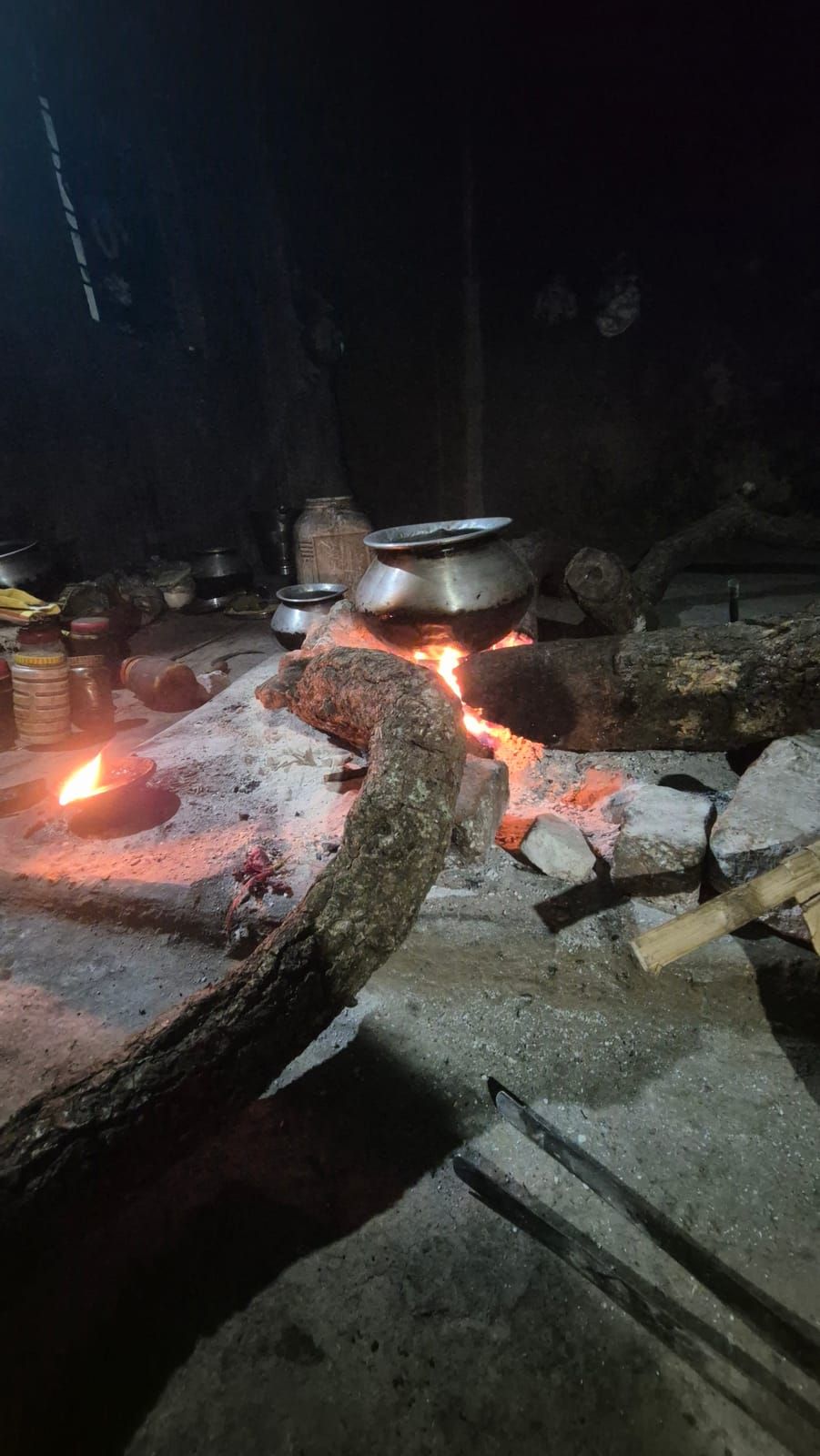
Babaji said, “We thought you were troublemakers from the Navdurga crowd, so why give you a mattress? Then we understood: you are parikrama walkers.”
Where have you come from, how did you meet Diederik, job, home, marriage… After these polite questions, the talk with Babaji ran through many colours and many topics.
Babaji introduced himself, and counted off his criminal cases too. But he told it so naturally, as if this is simply how every baba becomes a baba.
One moment he would ask softly, “What will you eat?” The next he was shouting about driving out the Muslims. Carried away, roaring with fervour about saving Hindutva from some pointless, imagined threat.
Talking to him became a game of snakes and ladders. Sometimes we were scared, sometimes we laughed, sometimes we just sat there thinking. We asked him questions out of genuine curiosity, but the answers came half-baked, with neither head nor tail.
From an hour of talk we learned this much: religion holds an important place in politics, and babas an important place in society. His claim was something like this: he had even got the local election won. Whatever he says comes true.
Every now and then Babaji made fun of Diederik. “Without money you won’t last one minute in India. Without the language, the villagers will beat you and throw you out.”
Curious Diederik became a cautious Diederik. In his mind, the outline of an exit plan began to take shape all by itself.
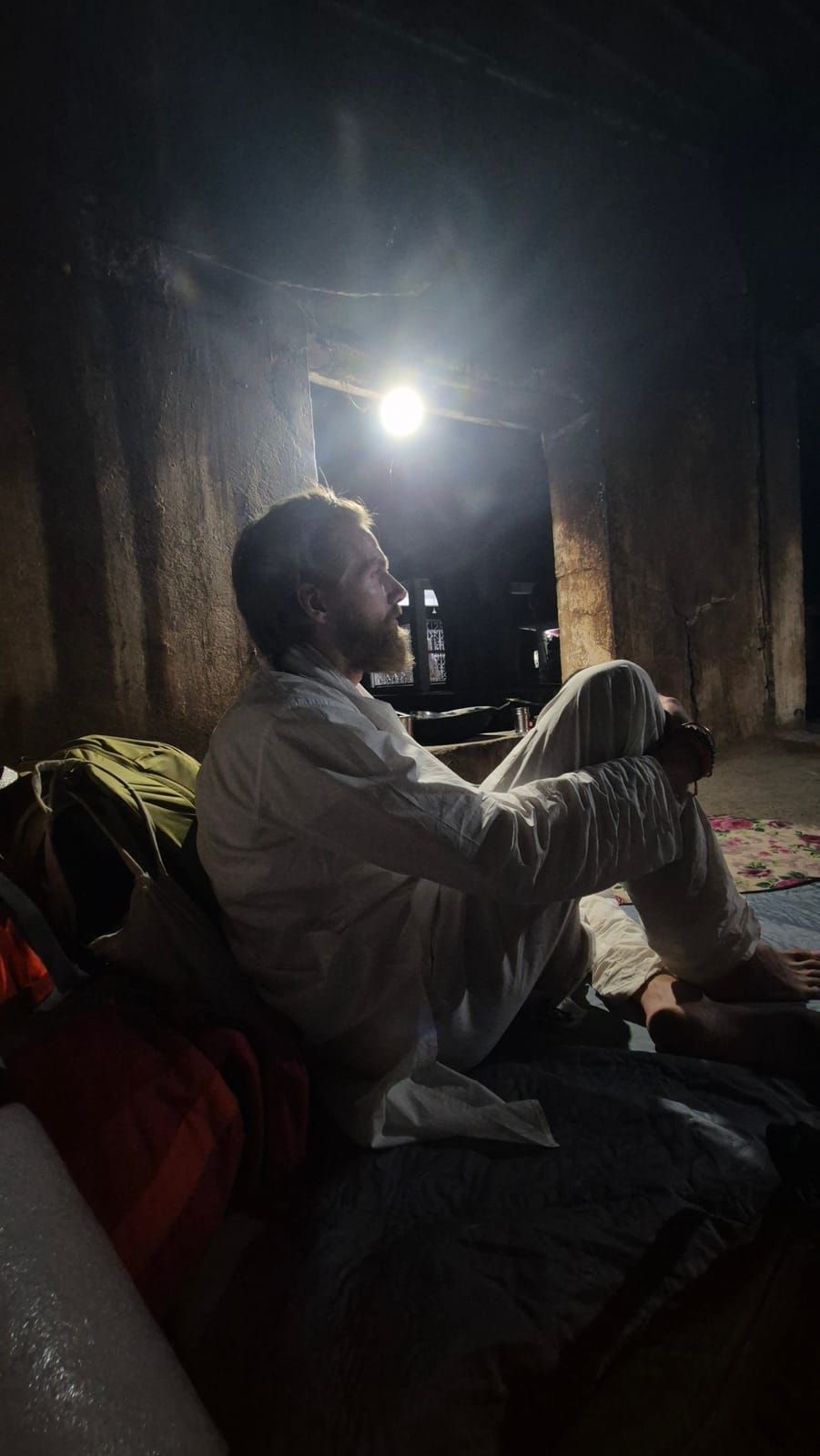
Just then Babaji switched again, like a radio changing channel.
“What will you eat? Shall I have puris made? If you want to cook yourselves, I’ll take out the rations. Nobody leaves Baba’s place hungry. Tell me, what shall I send for?”
Like the watches of the night, Babaji’s dual personality changed many times.
Whether I was there or not made no difference to him. All night the chillum kept being filled, and kept emptying into smoke.
Babaji’s radical ideas were deeply unsettling. He is a respected, important man here; the village listens to him, society listens to him. Yet in those two hours of talk he did not say one sensible thing.
Hindu–Muslim, the Ram Mandir, politics, and the fact that Diederik was walking the parikrama dressed like a politician: his needle stayed stuck right there.
Somehow we brought the talk to a close, and curled up in our beds in the warm glow of the dhuna.
Every watch of the night, without any alarm, my eyes opened. Sometimes I looked over at Diederik: is he still there? Sometimes he looked at me.
At half past five we got up. The night no longer seemed so strange.
Reva could not have slept either. Her birds, her fish, her trees, all of them must have been tired. That is why Reva seemed so still here. No longer dancing, no longer flowing kal-kal.
In the morning she had pulled a sheet of mist over herself, but even wrapped in it she did not dance. She seemed fast asleep.
Before leaving, we gave Reva a gentle shake, woke her, let her know, and walked on towards the next village.
Babaji sank into his morning routine, and we into our parikrama.
Reva’s bank is new every day, fresh every day. On this parikrama we live each day whole. We begin a life on one bank and end it on another. Every day the stage changes, the characters change, the play ends. And the next day it begins again.
This play is life itself.